Referendum in Southern Sudan and the Road to Independence
By Hon. Ezekiel Lol Gatkuoth, Head of Mission
Government of Southern Sudan Mission to the United States and the United Nations
February 24, 2011
Greetings Ladies and Gentlemen,
First, I would like to thank The Heritage Foundation for the opportunity to participate in today’s event to highlight the Referendum and the future of South Sudan.
The pro-democracy movements that are spreading throughout Africa and the Middle East may have started in South Sudan on January 9, 2011, when the world watched the people of Southern Sudan freely and peacefully choose their own future. Almost four million people registered to vote in the Referendum; 97.5% turned out to vote and 98.83% voted for secession (Independence of South Sudan) and for freedom, equality, justice and democracy.
The success of the Referendum reflects the singleness of purpose demonstrated by the people of Southern Sudan. Decades of violence, oppression and neglect by Sudan’s central government toward its citizens in the South created an environment that was ripe for change. Many feared that the Referendum could not happen on time or that it would spark a return to civil war. These concerns were valid, but the resolve of Southern Sudanese to participate in this long awaited and momentous occasion overcame logistical hurdles and attempts to derail peace.
The Government of Southern Sudan sincerely thanks the international community for standing with the people of Southern Sudan. The international community and the United States in particular were instrumental in helping the Sudanese People’s Liberation Movement and the National Congress Party negotiate the 2005 Comprehensive Peace Agreement that ended the civil war between the North and South and that provided for the 2011 Referendum. In addition, the international community has provided peacekeepers, technical support, and financial assistance to help secure peace, to provide emergency assistance as needed, to foster development and to help manage the logistical challenges of the Referendum. The international community’s keen focus on Sudan during the Referendum helped provide an environment that was conducive to a free and fair process.
The Government of Southern Sudan recently released its report on the work of the South Sudan 2011 Taskforce, which considers the Referendum, Post-Referendum, and Preparing the Government of Southern Sudan for July 2011. I would like to take a few minutes to highlight some of the key aspects of the report with regard to the future. The report is available on the Government of Southern Sudan website.
The Taskforce was established by President Salva Kiir and is chaired by Vice President Riek Machar Teny. The Taskforce subcommittees for each respective area are spearheaded by H.E. John Luk Jok, Minister for Legal Affairs and Constitutional Development; H.E. Pagan Amum Okiech, Minister for Peace and CPA Implementation; and H.E. Kosti Manibe Ngai, Minister for Cabinet Affairs. The Taskforce includes other ministers and key stakeholders including representatives from political parties, civil society organizations, and faith based groups.
As Southern Sudan prepares for independence, negotiations with the National Congress Party are ongoing and center around four key areas: citizenship; security; finance, economy and natural resources, which includes currency, banking, debts and assets; and international treaties and agreements. These negotiations have been facilitated by the African Union High Implementation Panel. The next round of high level meetings is scheduled for early March. In addition, ongoing negotiations are taking place with local stakeholders around border issues.
With regard to preparation for independent statehood, the focus is on six key areas: international relations; rule of law & citizenship; governance and executive leadership; economy and natural resource management; service delivery; and security and defense. This includes developing South Sudan’s constitution, building a cooperative relationship with the North and our neighbors, reviewing the role of UNMIS, and mobilizing resources for the new state. The Government of South Sudan has also identified five broad areas that need strengthened: public administration, rule of law, financial management, executive leadership, and natural resource management. The international community is needed to play a key role in transition planning and implementation.
Under the current Government of Sudan, the people of Southern Sudan have lived without access to education, healthcare, clean water, and life’s basic necessities. Providing these resources in addition to providing security, good governance and the opportunity for economic prosperity is a lot to deliver for a new government; however, we know that with a good vision; the support of our friends and through the hard work of our citizens, we now – through independence – have the opportunity and responsibility to create the future and country that we deserve. Again, we sincerely appreciate the support of the United States and we look forward to a long, mutually beneficial friendship that will enrich the lives of our citizens. Thank you.
==================
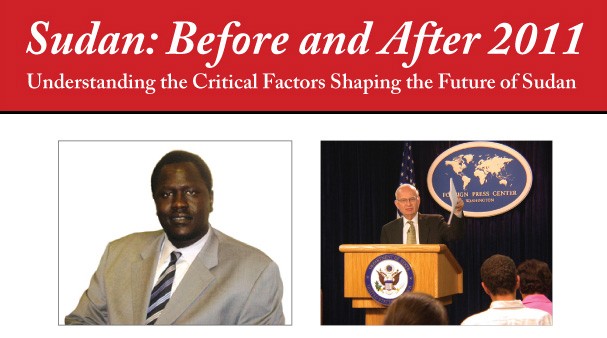
Sudan Before and After 2011
April 8, 2010
By Hon. Ezekiel Lol Gatkuoth, Head of Mission
Government of Southern Sudan Mission to the United States
Greetings Ladies and Gentlemen,
First, I would like to thank Weber Shandwick and Sergio Morales for honoring me with this opportunity and for providing a platform to discuss the current political situation in Sudan as we prepare for the elections this week and for the Referendum in January of 2011.
After 22 years of civil war, the Comprehensive Peace Agreement (CPA) was signed between the Government of Sudan and the Sudan Peoples’ Liberation Movement in 2005. The agreement ended the war and provided for the democratic transformation of Sudan and the opportunity for Southern Sudan to vote for separation in 2011.
Needless to say, these are important and historic events that the people of Sudan and the people of the region take very seriously. The people from the marginalized regions of Sudan reject the existing totalitarian regime of the National Congress Party (NCP) and are crying out for change. We demand the rightful recognition of our original identity, and we demand a system of governance that represents our diversity with equal citizenship, equal representation and equal distribution of national resources.
The CPA was carefully designed to allow a systematic set of events to occur that would allow for sustainable peace throughout Sudan. Specifically a process was established to allow for the democratic transformation of the state – a process that would allow the people of Sudan to choose their own leaders. For the past five years, the NCP has delayed and obstructed implementation of the CPA to the point that the Sudanese are not able to participate in free and fair elections.
In addition, it was understood that for Southern Sudan to choose unity in 2011, the NCP would need to make unity attractive. Southern Sudanese understood this to mean that the Government of Sudan would share the resources of the country with the South and not only rebuild what the North destroyed during the war, but in good faith help the South significantly develop its infrastructure and help develop healthcare, education and other essential services. This has not happened. Instead, the North has cheated the South of its share of oil revenues and has instigated instability in the South in order to undermine efforts for peace and development.
The SPLM, the primary party of Southern Sudan, is committed to the full implementation of the CPA, and the Government of Southern Sudan is committed to developing the people and resources of Southern Sudan.
The Government of Southern Sudan calls upon the international community, especially signatories of the CPA including the United States, which brokered the agreement, to oversee full implementation of the remaining provisions of the CPA; to provide protection for civilians throughout the election process; and to recognize and respect the will of the Southern Sudanese in 2011. The Referendum must be held on time. It is imperative that the international community works with the parties to arrange a peaceful divorce if that is the people’s choice and to help build the capacity of the Government of Southern Sudan.
We call on the international community to join hands with the marginalized people of Sudan to hold the perpetrators of injustices accountable; to help protect the people of Sudan as they seek to secure their rights; and to engage in developing the country in a way that promotes independence and prosperity.
Thank you for listening and thank you for your support.